
News

Stay updated with our latest developments. 

Innovative water storage for soft soils in Gouda

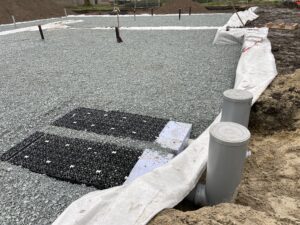
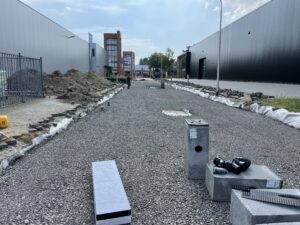
Road construction is challenging in Gouda’s peat soil: heavy foundations quickly sink into the soft ground. Aquaflow developed a lightweight alternative for its own water-retaining road foundation: Aquaflow Argimedes. The construction consists of strong plastic units with integrated connections for WT-gullies and roof water. The units are connected and wrapped with geotextile, creating a lightweight, stress-spreading layer that can also store water. With a thin layer of mixed granulate on top, the foundation is suitable for heavy traffic. This solution is being used at the new bus station and charging area for electric buses of Qbuzz on the Tielweg in Gouda and was constructed by Scherrenberg B.V.

Sustainable water storage in Maastricht

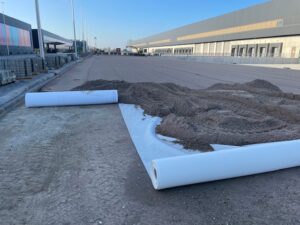
In Maastricht, 3,800 m² of Aquaflow has been installed for climate adaptation purposes. This provides a buffer for 550,000 liters of rainwater. Sustainability was central: contractor Van de Kreeke works electrically, and the Aquaflow crushed stone has a very low environmental cost indicator and was transported by ship. Due to the impermeable loess soil direct infiltration is not possible. Therefore, the water-retaining foundation is equipped with a waterproof film on the underside, so that the subsoil remains dry and stable. The water is discharged via drilled infiltration poles to deeper, permeable gravel layers. Asphalt has been applied directly to the foundation.

Oostkamp(B) wins the Openbaargroen Award

The Schoolstraat in Oostkamp has been declared the best garden street in Flanders: green, climate-resistant, and liveable. An important part of the winning design by engineering firm Lobelle is almost 3,000 m² of paving with park stone and small park stone. Contractor Ivan Vuylsteke bv installed this paving harmoniously around the garden areas and planting.

Microbes Purify Rainwater

We sometimes receive the question whether bacteria die when no nutrients are available. Fortunately, this is not the case, and there are several reasons for this. The Aquaflow microbial product contains essential nutrients such as nitrogen (N) and phosphorus (P), as well as trace elements in a slow-release form. These stimulate the development of the bacteria. Additionally, the product contains a small amount of organic material (not oil), which serves as a carbon source. This helps the bacteria during the start-up phase, allowing them to multiply and grow. When this carbon source is depleted and no other available carbon is present in the soil, the bacteria can survive by entering a dormant state. They do this by, for

House Connection 2x 200 Mm on a Water-Retaining Parking Lot in Eindhoven

Over the years, Aquaflow has developed many innovative solutions for water-retaining roads. In the photo, you can see the house connections of two apartment complexes, each with a diameter of 200 mm. The Permavoid connector XL-200 mm is still visible and will be carefully covered with geotextile later.

Rainwater from the Street, Purifying Oil and Gasoline, with a Geotextile?

At Schiphol, 35,000 m2 of oil-processing filter fabric (PF90) is laid under the pavement as part of a Breeam excellent certification. This specially designed filter fabric blocks 100% of hydrocarbons, preventing oil and gasoline particles from penetrating the soil. As rainwater seeps into the ground, the contamination is captured in the fabric and then naturally broken down by added microbes. It is easy to apply and ensures that the soil remains clean and the environment is protected.

Monitor the Water Level Remotely (in the Water-Retaining Road)?

With Flowfacts, you can track in real-time and remotely how the water storage fills and empties. The photo shows an innovative contactless water level sensor, which is attached to the lid of the drain. The water level in this drain is equal to the water level in the water storage.

Discover Aquaflow’s Sustainable Innovations at the Climate Expo on April 17-18!

At Aquaflow, you will find a circular water-retaining road, equipped with Flowfacts water level sensors for accurate monitoring. We have also integrated a toad ladder to allow amphibians to safely climb out of the water catch basins, and our oil-processing filter fabric is perfectly suited for BREEAM projects and areas with vulnerable groundwater. Read more about our solutions in the article in Straatbeeld.

Why is a Design with the Park Stone so Attractive?

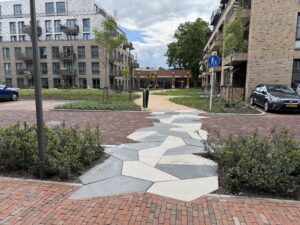
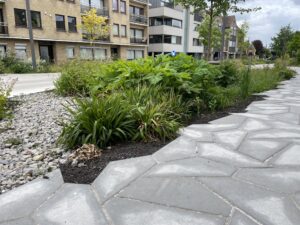
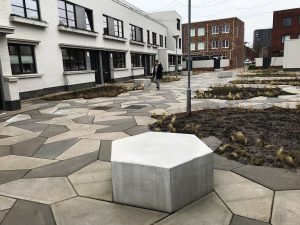
With the park stone, the straight lines of classic street work can be abandoned. The pattern provides design freedom and a natural transition between paving and greenery. Enk Groen en Golf sent us a beautiful photo of the Heycop project in Utrecht with 750 m2 of Park Stones.

Aquaflow with Circular Natural Stone Granulate in Culemborg

Innovative indeed: a water-retaining road foundation made of circular natural stone granulate that matches the performance of new materials. A sustainable choice for water storage. In Culemborg, this was a deliberate choice (see Straatbeeld article on website).

To Infiltrate or not in Kerkrade?

To Infiltrate or not in Kerkrade? In the barely permeable loess soil in Kerkrade, Wegenbouw Kurvers installed an Aquaflow system to buffer 120 m3 of water. But how does a water-retaining road in impermeable soil drain? The most common method is a restricted outflow, allowing the buffer to slowly drain elsewhere. However, in South Limburg, beneath the impermeable clay layer, a gravel layer or coarse sand is often present. Therefore, at Old Hickoryplein, a 6-meter deep shaft was dug to infiltrate rainwater into the deeper, well-permeable gravel layers.

Rainwater not in the ditch? Why not?

Rainwater not in the ditch? Why not? In our discussions, we talk with you about the future of urban rainwater policy. Where is it headed? Will we experience more flooding or, conversely, drought? Shouldn’t rainwater first go into the soil and only then into the ditch?

A Design to Connect People in Breda

A Design to Connect People in Breda How do you ensure mutual cohesion in a new neighborhood? One way is by ensuring that residents meet and get to know each other. To contribute to this, BuroBol has designed special street furniture for the Drie Hoefijzers plan in Breda. A concrete “pouf” that fits into the park stone laying pattern, where residents can sit for a chat.

Nearly 2-Meter Thick Aquaflow Package in Wezep

Nearly 2-Meter Thick Aquaflow Package in Wezep A large storage requirement and limited space. This was the case in the new development plan “Zeuven Heuvels” in Wezep (municipality of Oldenbroek) which has now been completed. The solution was found in an Aquaflow water-storing road with a thicker foundation package. In some places, Aquaflow was installed 190cm thick, allowing> 700 liters/m2 of rainwater to be buffered.

Municipality of Papendrecht Installs Ultrasonic Level Measurement in Aquaflow System

Municipality of Papendrecht Installs Ultrasonic Level Measurement in Aquaflow System Knowing what’s happening by being able to monitor the water level and drainage time on any screen at any moment. This is possible in the Aquaflow system in Papendrecht. Beneath the water-retaining road lies drainage to maintain groundwater at a constant level. Infiltrate when possible, discharge when necessary. This is crucial in an area where the soil partly consists of peat. How does it function now? With Flowfacts, they now know exactly.

Flowsand with Zoak Stone, Solution for Heat Stress

Flowsand with Zoak Stone, Solution for Heat Stress Can climate-adaptive paving reduce heat stress? “Yes,” is the answer from the Amsterdam University of Applied Sciences. The research was conducted using the baked Zoak stone on a street layer of Flowsand. This makes the street a sponge, retaining water to cool on summer days. The result: the street remains about 12°C cooler than regular pavement. Thus, the excessive heat, as far as the street is concerned, is virtually eliminated.

This Way, You Know Exactly how the Water Storage Functions!

This Way, You Know Exactly how the Water Storage Functions! More and more Aquaflow projects are being made intelligent by installing Flowfacts. The functioning of the storage can then be monitored remotely and in real time on a PC, smartphone, or main station. The most notable observations so far are: long drainage time (the k-value turns out to be lower than expected) and excessive flow restriction, causing the system to barely fill. This makes Flowfacts quickly pay for itself. With better insight, often through small optimizations, the robustness of the water storage is improved.